
You want to change one thing on your website. A price, your hours, a photo. You go to log in, and you cannot. The person who built the site years ago has the login, and the domain sits in their account, not yours. You call. You leave a message. Nobody calls back.
This is one of the most common things I see, and one of the most avoidable. The business pays for the site every month and assumes it owns it. It does not. Someone else holds the keys, and nobody notices until the day they reach for them.
I have spent more than twenty years building the sites and systems businesses run on. Web and application development, databases and reporting, the booking and CRM code that ties one tool to another. I have also worked where the technology physically breaks: point-of-sale counters, network closets, fiber in the ground. I build the site and the systems behind it, and I stay reachable after it ships. And a good part of the work is simpler than any of that. I get people back the keys to what they already own.
It is not always someone holding your site hostage on purpose. More often it is quieter. The domain was registered under an email nobody checks anymore. The hosting sits in an account set up by a person who has since left. The web guy who did all of it moved on and never handed anything over, with no bad intent, just a gap nobody thought to close. Then you want to switch hosts, or fix something yourself, or just renew, and you cannot, because the only account that can is one you have no way into. Your website is a hostage even when no one is holding it for ransom.
The Google listing is the same story. It sits in an old Gmail account nobody has the password to, or with a marketing company you stopped paying two years ago, and you cannot fix your own hours or address without tracking down whoever first set it up. There is an official process to claw it back. It takes weeks, and your listing is wrong the whole time.
Then there is the backup, the quietest one of all. Almost every business has one, or believes it does. A line item, a monthly charge, a green checkmark someone saw once. Then a drive dies or a file gets deleted, and they go to restore, and the backup stopped running months ago, or only ever copied the wrong folder, or nobody ever tried it and it does not actually work. The safety net was never tested. They learn that at the exact moment they are falling.
Here is why this keeps happening. Setting it up right the first time costs a little today. Skipping it costs nothing today and a great deal on some future day nobody wants to picture. When a boring system works, it sends no thank-you note. A disaster that did not happen leaves no receipt. So nobody checks, and the day someone finally does, it is already an emergency.
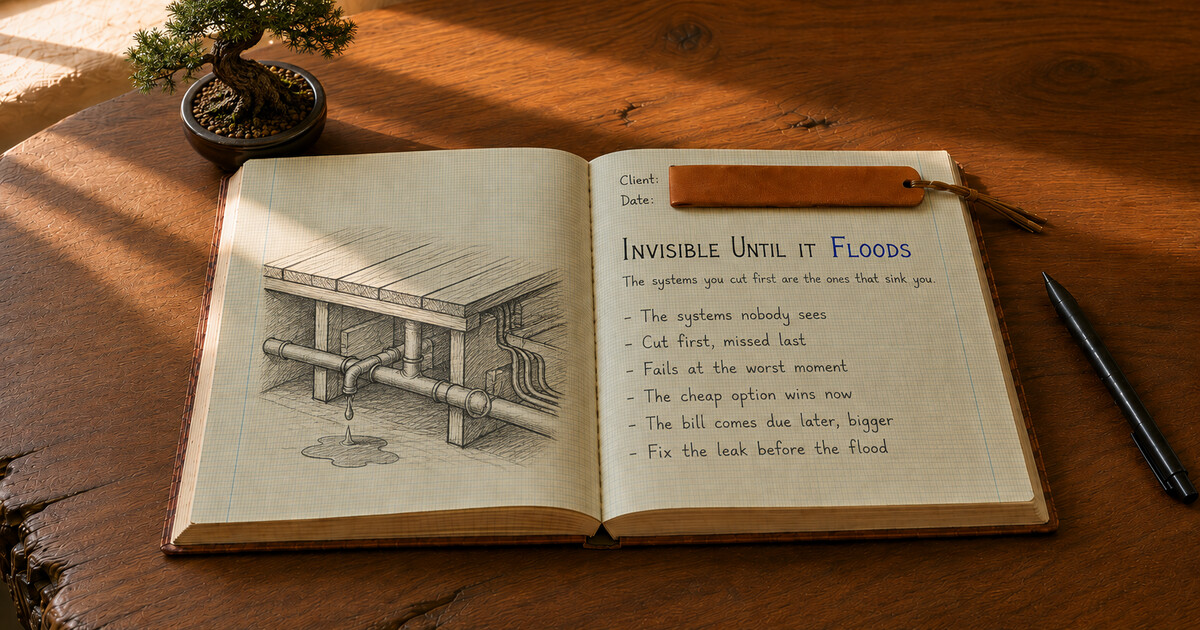
None of this is negligence. This plumbing is invisible by design. It is built to run without anyone watching, which is the exact reason no one is watching when it stops. You cannot manage what you cannot see.
The fix is cheap next to the emergency, and most of it is not a purchase at all. Find out what your business actually owns and controls. Get the domain, the hosting, and the accounts back in your name, where a vendor moving on cannot take them along. Test the backup by actually restoring from it, before you need to. Write down where each thing lives. That is ownership, and it is worth far more than the line item it hides in.
That is the work I do. I find the things a business is trusting without proof, I get the keys back into the owner’s hands, and I make sure the safety net would really hold, simply, so it all still works when it matters.
So try it now. Go log in to your own website, your domain registrar, and your Google listing. If you can get into all three, you are in better shape than most. If you cannot, you just found the thing that will cost you on your worst day instead of this quiet afternoon. If you cannot see it, you cannot fix it.