
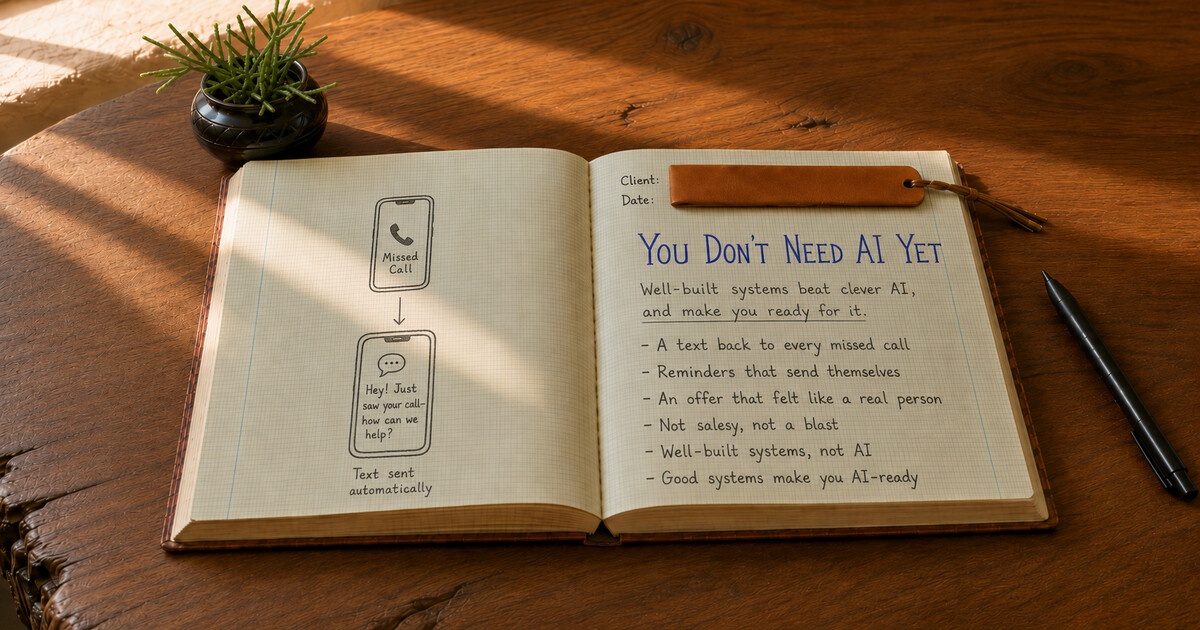
A dental practice I worked with was losing people in the gaps. When the front desk could not pick up, the call just went unanswered. Sometimes it was a new patient shopping around, who called the next office. Sometimes it was a current patient trying to book, who gave up. Either way, the practice never knew the call had happened. Confirmations and reminders went out by hand, one call at a time, so some never went out at all and patients no-showed.
I built them a set of automatic texts to close those gaps. Now when a call is missed, a text goes straight back to the caller. The front desk gets a heads-up at the same moment, so they can pick the conversation up later instead of losing it. Confirmations and reminders send themselves on a schedule: a day before, an hour before, and a last nudge about fifteen minutes out. Enough to keep people on time without pestering them. Missed calls stopped slipping through. The no-shows dropped, and patients liked it better than the phone calls. None of it was AI. But none of it was a toggle you flip, either. It took the right tools and real design to make a system like that run smoothly.
Once the system was running, they wanted to know whether patients would welcome an offer through it or resent one. So I was careful. The message did not read like an ad. It read like a friendly note from a front-desk person the patients already knew, saying the dentist was running a special on whitening, the trays and the extra gel, in case they wanted it. She answered every reply herself, with me coaching from the side. A patient who wrote back reached that same familiar person, not me pretending to be her and not a bot.
It worked because it never felt like a sales pitch. Whitening bookings went up. The trays and gel sold along with them. A few patients booked larger procedures nobody had planned. The same message would have flopped as an automated-feeling blast, or annoyed people. The automation carried it. The restraint and the human hand made it land.
This is what practical automation looks like for a small business, and it is not AI, at least not at first. The hype pushes owners toward expensive tools to look modern. The money is sitting somewhere quieter: the text back to a missed call, the reminder that goes out on its own, the offer that finally reaches the people who would have said yes. Most owners never set these up. It takes real design to make them run smoothly and still feel like a person sent them, which is exactly why they get left undone. A system like that beats clever AI. And it does something the AI shoppers miss. It puts the business in order, which is what makes it ready for AI instead of choking on it.
Where does AI actually fit? On top of clean data, once you have any. Most businesses do not have it yet. Point AI at half-entered, duplicated, out-of-date records and it hands you confident, well-worded nonsense. Get the data clean first, and only then does AI have something worth analyzing. That is where it gets genuinely powerful.
Here is the order that makes money. Turn on the boring automation first: the missed-call text back, the confirmations, the reminders, the offer that never went out. Run it with enough care that people are glad to hear from you. Then get your data organized, because most of it is likely a mess. It sits scattered, a little in one tool, a little in another, some of it in one person’s head, entered a different way every time. Put it in one place, settle on one way to record it, and clean up what is already there. Once that is solid, add the AI on top, trained on the replies that already worked. It will carry most of the routine, with a person still stepping in where it matters.
Do that, and you will quietly out-earn the businesses pouring money into tools they are not ready to use. You probably do not need AI yet. You need the plumbing nobody wants to touch, turned on and done right.